


How to Check if a TikTok Influencer Has Fake Followers or a Bot Audience (2026 Guide)
A large TikTok following does not always mean an influencer has a real and active audience. This guide shows how to spot fake followers, identify bot activity, and check audience quality before a brand deal.

A brand we work with paid premium rate for a TikTok creator with 480,000 followers. The video shipped on schedule, the creative was good, and it finished with 11,000 views. Not 11,000 views on day one. Eleven thousand, total. The creator had bought roughly half their audience two years earlier, and those accounts had never watched a single second of anything.
Here is what most guides get wrong. To check if a TikTok influencer has fake followers, you compare their engagement rate against TikTok-specific bands (not Instagram’s), read their comment section for generic filler, and look for growth spikes that do not match any viral video. But the reason this matters more on TikTok than anywhere else is mechanical: bought followers never watch, and watch time is what TikTok’s ranking system actually feeds on. A padded audience on Instagram inflates a number. A padded audience on TikTok inflates a number and contributes nothing to the signals that earn the creator reach.
We call this the FYP Penalty, and it is the part of this problem every checker-tool page skips.
The scale of fake followers on TikTok
TikTok publishes enforcement data, and the volume is genuinely large. In the first half of 2024, the platform reported preventing over 700 million fake accounts from being created and preventing more than 36 billion fake likes, while removing a further 379 million fake likes and over 207 million fake followers. In Q3 2025, TikTok removed roughly 118 million fake accounts in that quarter alone.
Those numbers describe the supply side. The demand side is what should concern anyone allocating budget.
A March 2026 study by SociaVault Labs, which analysed 100,000 Instagram and TikTok accounts, put the share of followers that are fake or suspicious at 37.2% across both platforms, with TikTok specifically at 32.6% against Instagram’s 41.8%. TikTok is cleaner than Instagram. It is not clean.
One caution on the research in this space. Several widely circulated 2026 fraud statistics, including a frequently cited “8.7 million profiles, 41.3% fraud rate” study attributed to HypeAuditor, do not trace back to any published report from the vendor named. We have cited only figures we could verify against a primary or methodologically disclosed source, and we would encourage you to apply the same test to any number you see quoted on this topic.
Why TikTok fake followers hurt differently than Instagram’s
This is the section that justifies treating TikTok as its own problem rather than porting Instagram advice across.
On Instagram, distribution is heavily anchored to the follower graph. If a creator has 500,000 followers, a meaningful share of those accounts get served the post. Bots inside that base sit there quietly and dilute the engagement rate. The damage is reputational and financial: you paid for reach that does not exist.
On TikTok, distribution is earned per video. TikTok’s recommendation system ranks each video against predicted interactions for each individual viewer, weighting signals like whether someone finishes the video, skips it, likes it, shares it, or comments. Follow relationships are one input among many, so it is not accurate to say the follower graph is irrelevant. But it is a far weaker lever than it is on Instagram, and the strongest signals in the mix are behavioural.
That difference produces three distinct problems for a bot-padded TikTok account.
Bots generate no watch time. The early performance window of a TikTok video depends on real humans completing it. A follower base that is one-third automated contributes exactly nothing to that window. The creator is not just misrepresenting their audience to you. They have hollowed out the input their own reach depends on.
Padding mechanically depresses measured engagement rate. Engagement rate on TikTok is calculated as likes plus comments plus shares, divided by followers. Add 100,000 bots to the denominator and the rate falls, whether or not anything else changes. This is why a low engagement rate relative to tier is a more reliable fraud signal on TikTok than it is on Instagram.
Enforcement is a live risk to your campaign. TikTok’s Integrity and Authenticity policy states that when it detects accounts or content with inauthentic metrics, it removes fake likes, followers, and other inflated signals. TikTok also maintains a separate enforcement category making accounts ineligible for recommendation in the For You feed. A creator with a purchased audience is carrying a risk that can land mid-campaign.
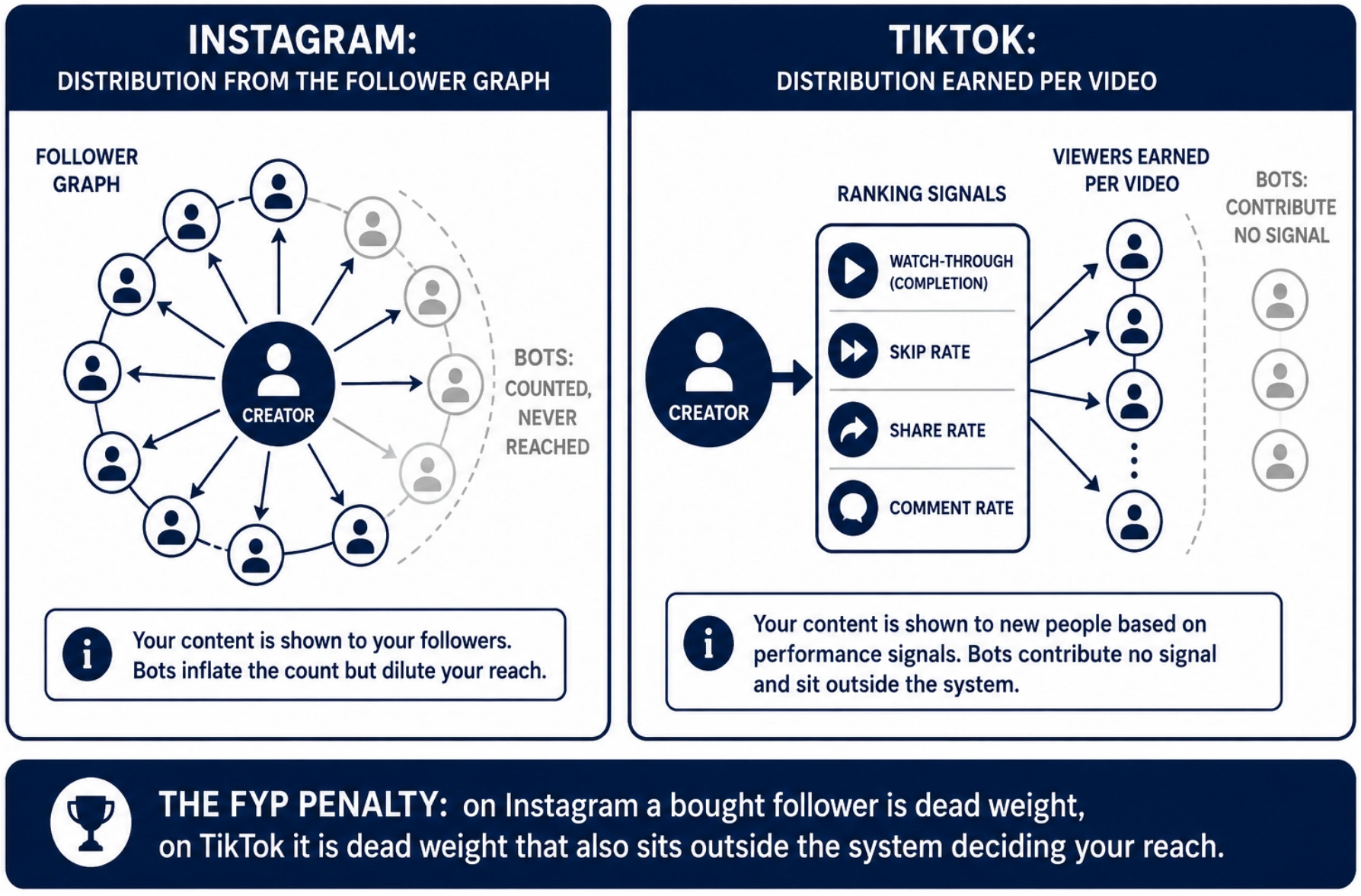
The practical consequence: you cannot evaluate a TikTok creator with Instagram thresholds. And the direction of that adjustment surprises most people, which is the next section.
TikTok engagement rate benchmarks for 2026
The most common mistake we see in creator vetting is applying Instagram’s 1% to 3% range to TikTok and concluding that a 3% creator looks strong. On TikTok, 3% is below the platform median.
SociaVault Labs’ 2026 analysis of 150,000 TikTok accounts puts the median engagement rate at 4.25% across all tiers, against roughly 1% on Instagram. Here is the tier breakdown:
Source: SociaVault Labs, 2026 (150,000 TikTok accounts, screened for fraudulent activity). Formula: likes + comments + shares, divided by followers.
Two things to hold onto. First, engagement rate falls predictably as follower count rises, so a 2.5% macro creator is performing normally and a 2.5% nano creator is a red flag. Compare within tier, never against the platform average. Second, niche moves the number as much as size does: entertainment and comedy sit at a 6.92% median while fashion sits at 3.21%, so a fashion creator at 4% is outperforming their category.
TikTok’s overall median has also declined about 17% over two years, from 5.10% in 2024 to 4.25% in 2026, as the platform matures. If you are working from a benchmark table published before 2025, your thresholds are too high.
You can check any creator against current bands with our TikTok engagement rate benchmark tool.
Method 1: The Five-Signal TikTok Audience Check
This is the manual pass. It takes about ten minutes per creator and costs nothing. Run it before you put anyone on a shortlist.
Signal 1: Comment specificity. Open the last five videos and read the top thirty comments on each. Real audiences reference what happened in the video. Bot and pod comments are content-agnostic: single emojis, “love this”, “so true”, “amazing content”. One caveat that matters in 2026, covered further down: generic no longer means bot.
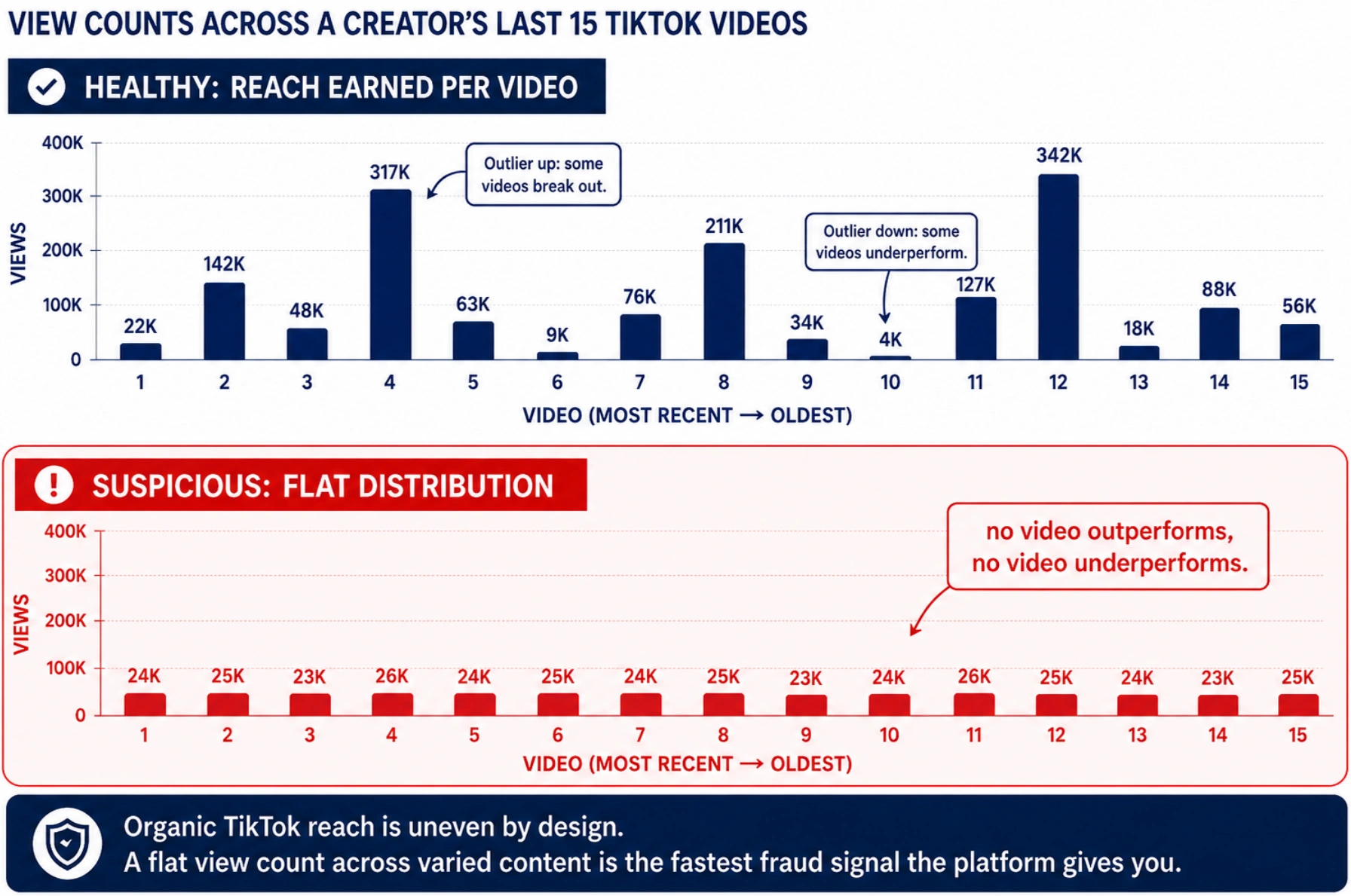
Signal 2: View consistency across videos. This is TikTok-specific and it is the fastest tell available. Because reach is earned per video, a healthy creator’s view counts vary a lot. You expect a spread. What you do not expect is a flat line. When every video lands within a narrow band regardless of quality or topic, that pattern is more consistent with purchased views than with organic distribution.
Signal 3: Views against followers. A creator with 300,000 followers whose recent videos average 8,000 views is functionally an 8,000-reach account. Their follower count is a historical artifact. This does not always mean fraud (an audience can decay after a viral moment), but it always means you are paying for the wrong number.
Signal 4: Growth spikes with no cause. Pull up the growth chart. Organic TikTok growth is spiky, but every spike has a video attached to it. A jump of 40,000 followers in a week with nothing in the content history to explain it is a purchase. Round-number jumps are a further tell.
Signal 5: Duets, stitches, and shares. This is the authenticity signal TikTok offers that Instagram does not. Bots do not duet. They do not stitch. They rarely share. A creator with a large follower count and near-zero duets, stitches, or shares on their best-performing content has an audience that consumes passively at best, and does not exist at worst. Shares are also weighted in TikTok’s engagement formula, so this signal shows up in the numbers as well as in the interface.
Any single signal can have an innocent explanation. Three or more together is a pattern.
Method 2: Free tools worth using
Manual checks catch obvious fraud. Tools catch the rest.
Modash publishes the clearest public framework for audience quality, and it is worth citing directly because it is honest about what normal looks like. Modash breaks a creator’s audience into five categories: real people, notable followers (accounts with over 1,000 followers of their own), real mass followers (real people following over 1,500 accounts), suspicious mass (fake accounts following over 1,500), and suspicious accounts (fake accounts with clear bot markers such as no profile picture, no posts, and generic usernames).
Their working thresholds: bigger creators typically carry roughly 20% to 30% fake followers, smaller creators under 50,000 followers sit around 10% to 20%, under 25% is the range to aim for, and above 50% should be avoided entirely. Modash also notes that a perfect 100% score is unusual, because bots follow accounts organically looking for follow-backs and every legitimate creator accumulates some over time.
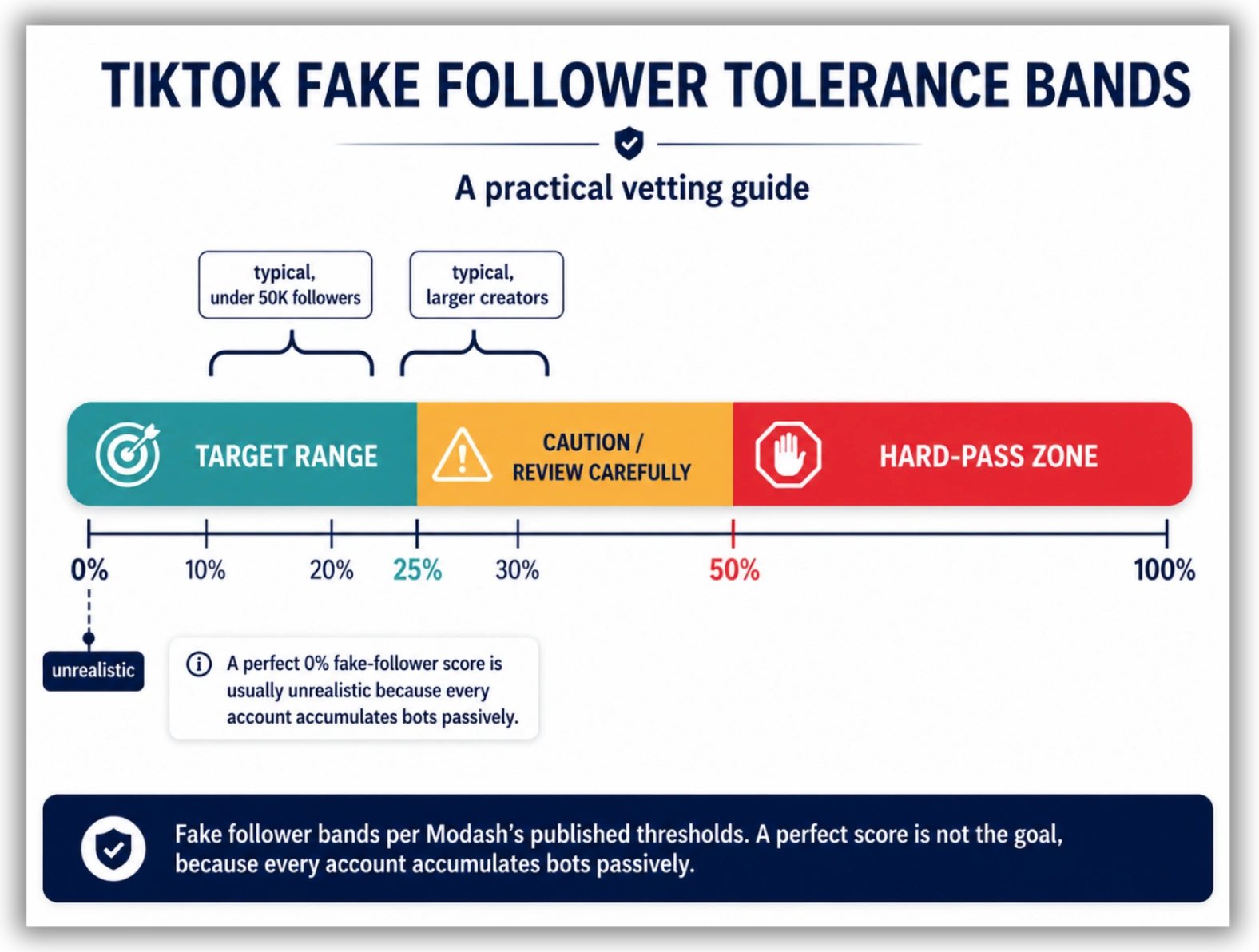
That last point deserves emphasis, because zero-tolerance vetting is its own failure mode. A creator with 15% fake followers and a 5% engagement rate is a good partner. A creator with 15% fake followers and a 1% engagement rate has a deeper problem than the percentage suggests.
HypeAuditor offers an Audience Quality Score with TikTok coverage. Heepsy and Collabstr both run free surface-level scans that are useful for a first filter.
The gap across all of them, including Modash, is that they apply the same audience-quality model to Instagram and TikTok. That model is built on follower-graph signals: profile completeness, following ratios, account age, posting activity. Those signals are real, and they work. They just do not capture the thing that determines whether a TikTok campaign performs, which is whether anyone actually watches.
Method 3: How to check if a TikTok influencer has fake followers using Favikon
Six steps, roughly two minutes per creator.
1. Search the creator. Open Favikon’s TikTok profile analyzer and enter the handle, or find candidates from scratch through TikTok influencer discovery.
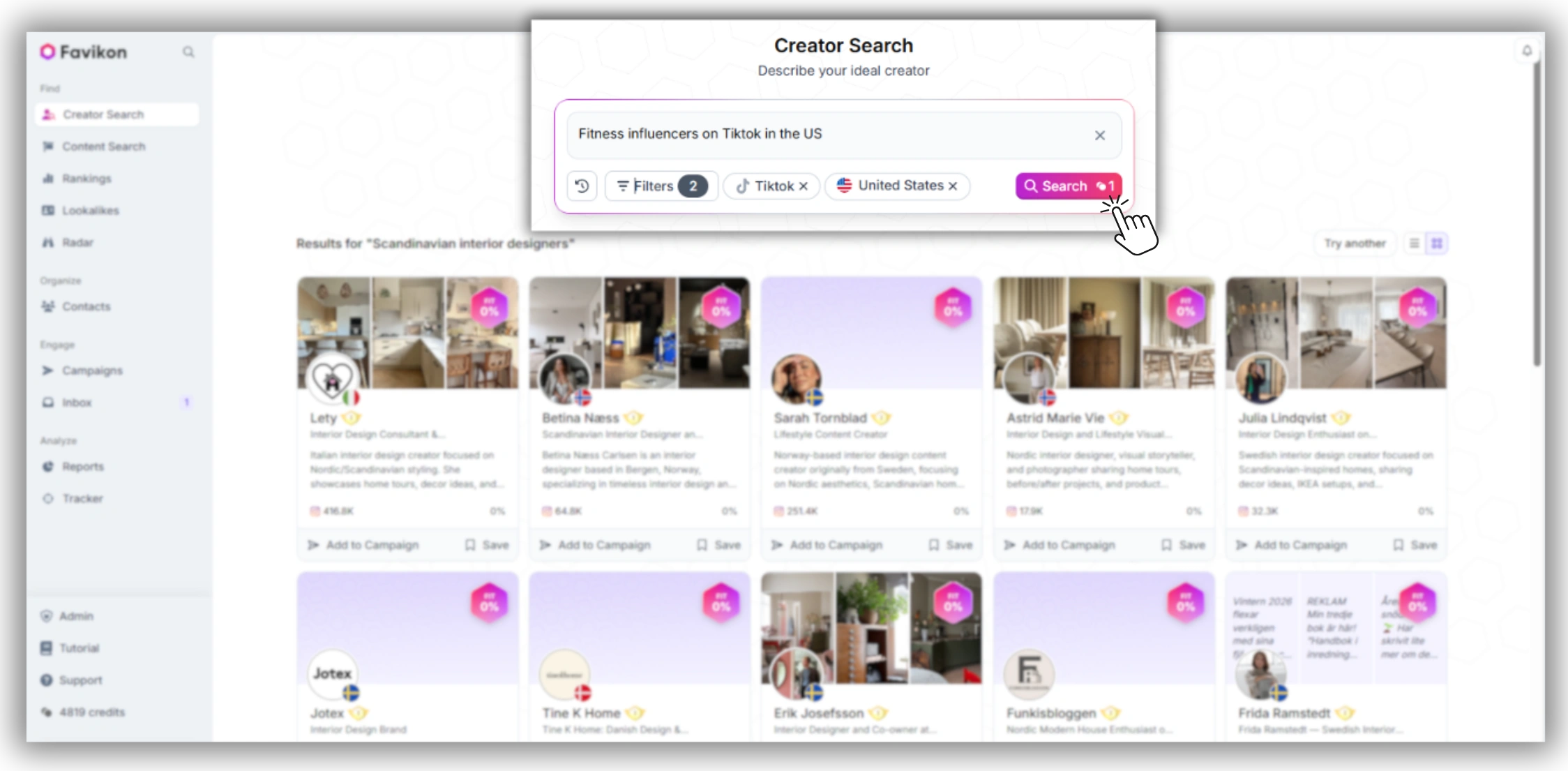
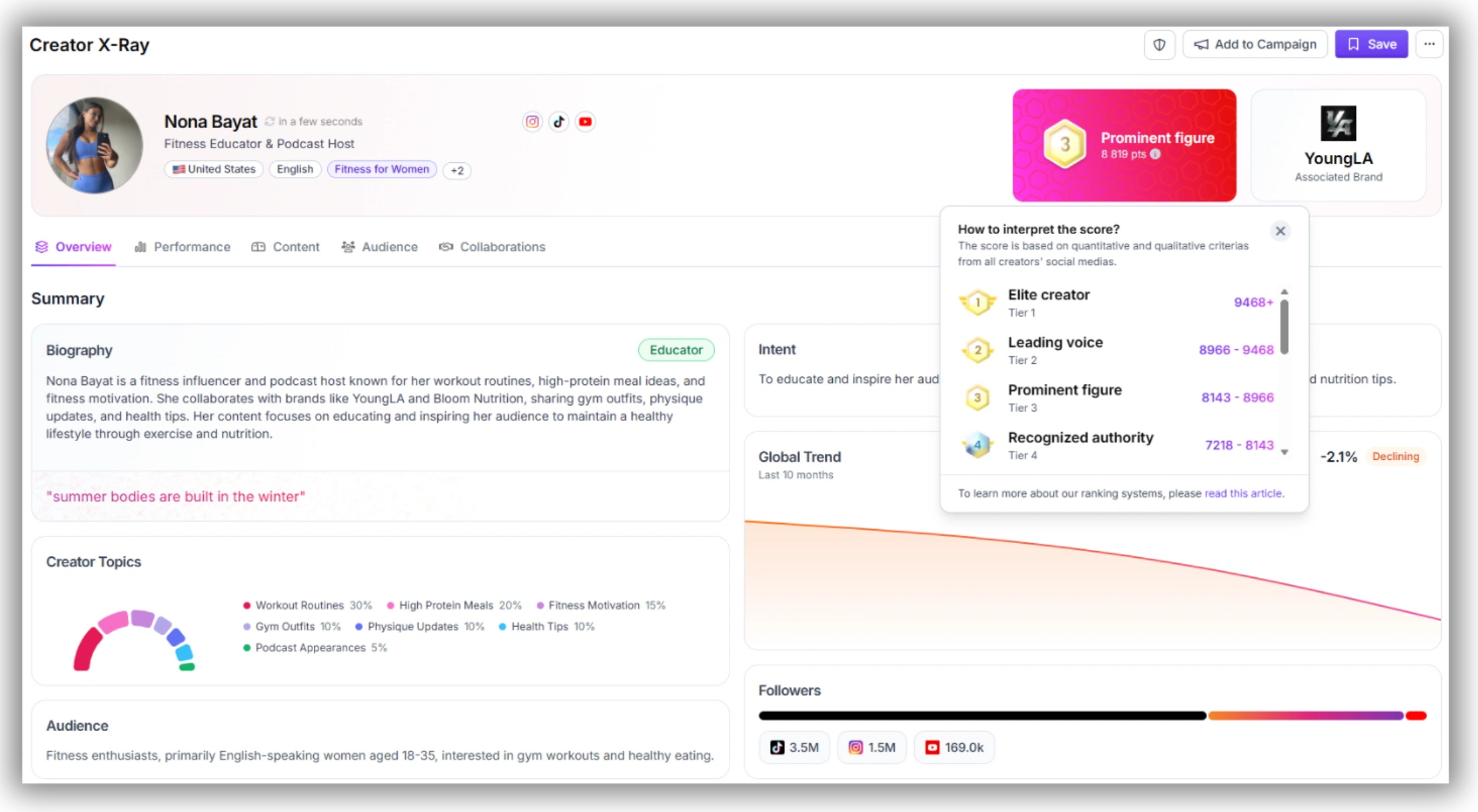
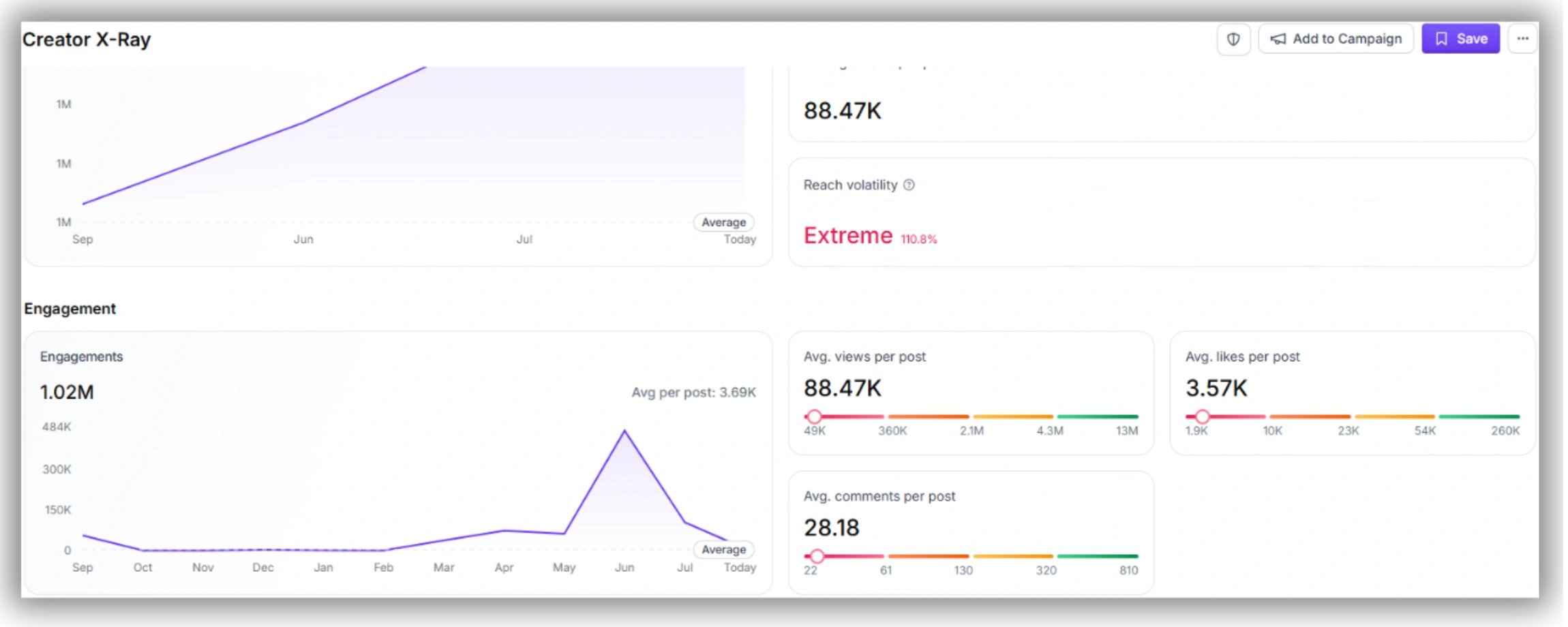
2. Open the profile view. You get follower count, engagement rate, posting cadence, and content categories in one place, with the engagement rate already calculated against their tier rather than against a platform-wide average.
3. Read the Authority Score. This is our composite creator quality metric. It weights audience authenticity alongside reach and consistency, so a large account with a weak audience does not score well simply for being large. Our full creator evaluation methodology explains the inputs.
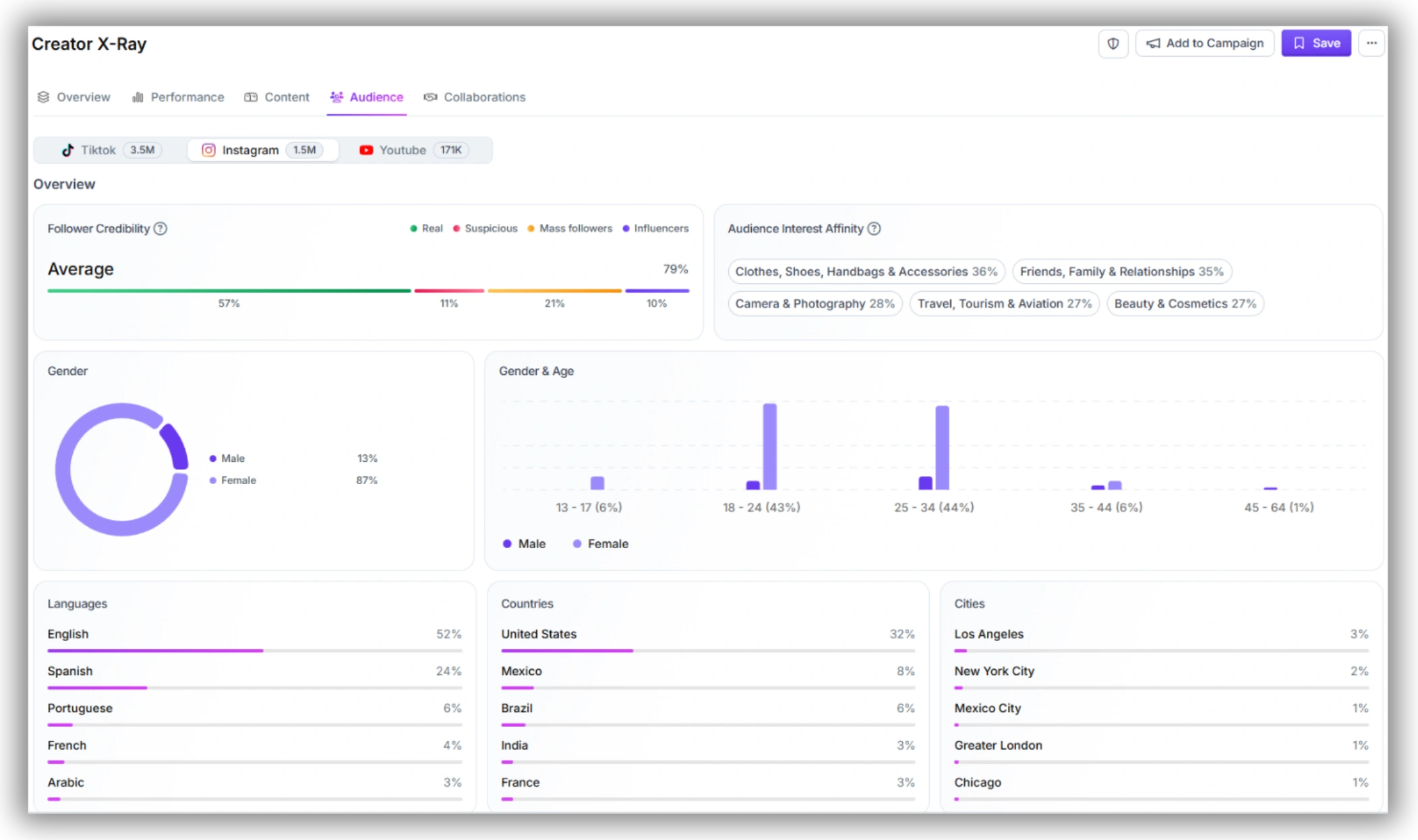
4. Check audience credibility. The share of the follower base flagged as authentic, with the suspicious portion broken out.
5. Read the growth chart. Look for the spike-with-no-cause pattern from Signal 4. Our chart plots follower growth against posting activity, so unexplained jumps are visible without cross-referencing anything.
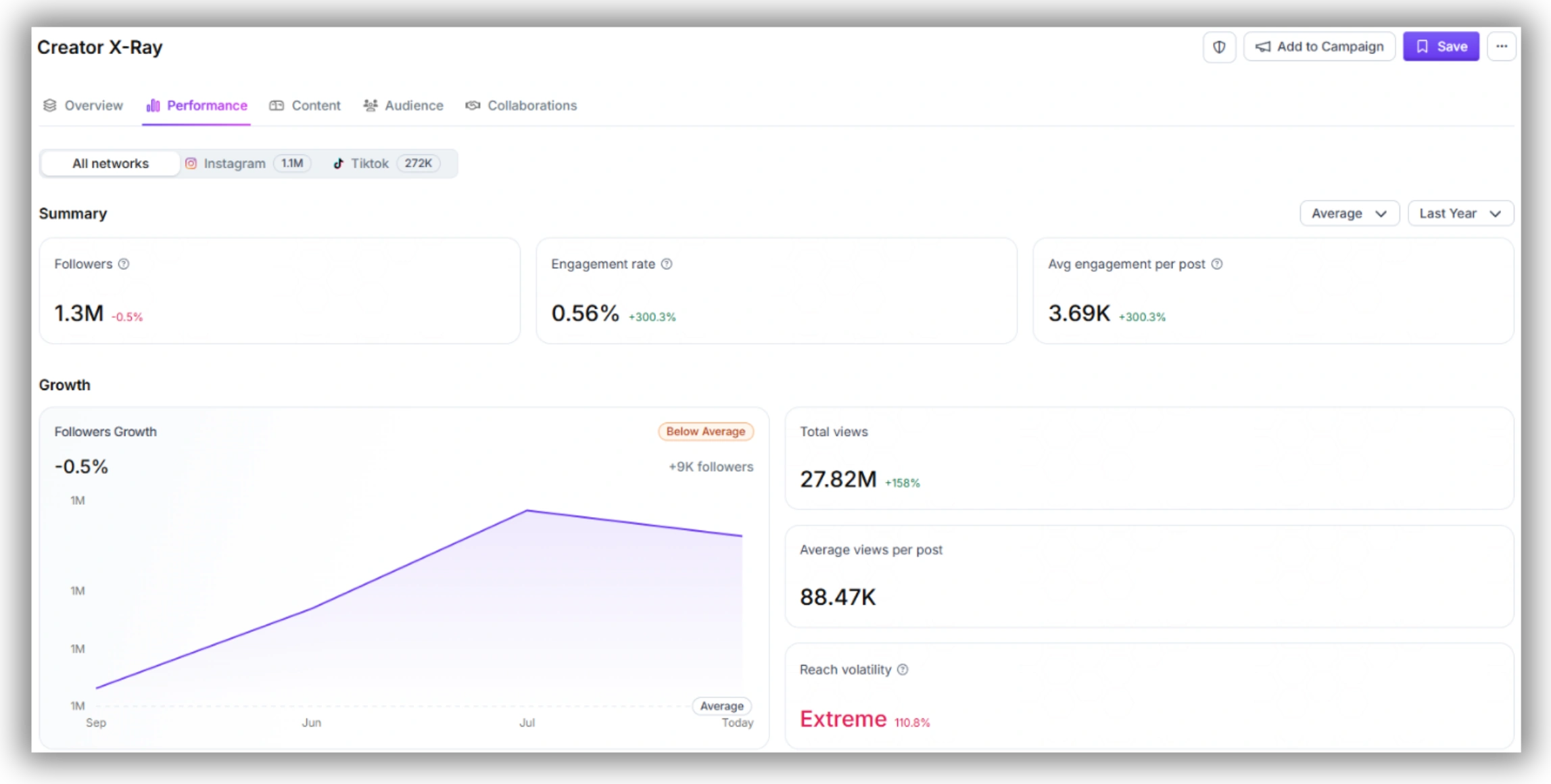
6. Check the engagement pattern. Not just the headline rate, but the distribution across recent videos. Consistent engagement across a varied view count is healthy. Consistent engagement across a suspiciously flat view count is not.
Vetting TikTok creators at volume? Fake audience detection runs on every TikTok profile in Favikon, so you can filter a shortlist by audience credibility before you send a single outreach email. Try it free.
How Favikon detects fake audiences on TikTok
Our TikTok model uses the standard follower-graph signals that every serious tool uses, and then adds the behavioural layer that TikTok makes possible and Instagram largely does not.
On the audience side, we score follower accounts on profile completeness, following-to-follower ratios, account age, posting history, and growth pattern irregularities. Accounts that fall outside normal behavioural distributions get flagged.
On the content side, we weight signals that only exist because TikTok distributes per video. View-count variance across a creator’s recent uploads tells us whether their reach is being earned or purchased. The ratio of shares and saves to likes tells us whether an audience is acting on content or passively registering it, and bought engagement is heavily skewed toward likes because likes are the cheapest thing to buy. Comment-to-like ratios that sit far outside category norms indicate either purchased comments or purchased likes, depending on which direction they skew.
The combination matters more than either half. An account can look clean on follower-graph signals and still show a content-signal profile that does not hold together.
What changed in 2026: AI-generated comments
The comment-quality test, which was the most reliable manual signal for years, is degrading fast.
Bot comments used to be trivially identifiable because they were content-agnostic. A bot could not reference what happened in a video, because it did not process the video. That constraint is gone. Engagement services now run multimodal models over the video before generating comments, producing responses that reference the actual content: the outfit in the third shot, the punchline, the recipe step the creator skipped.
What this means practically:
Generic comments still indicate a problem, but specific comments no longer prove authenticity. The test has become one-directional. Filler comments are still a red flag. The absence of filler comments is no longer a green light.
Timing distribution is now the stronger signal. Real comment activity clusters heavily in the first hours after posting and then trails off with a long tail. Purchased comments arrive in batches, often at even intervals, sometimes long after the video stopped being served to anyone.
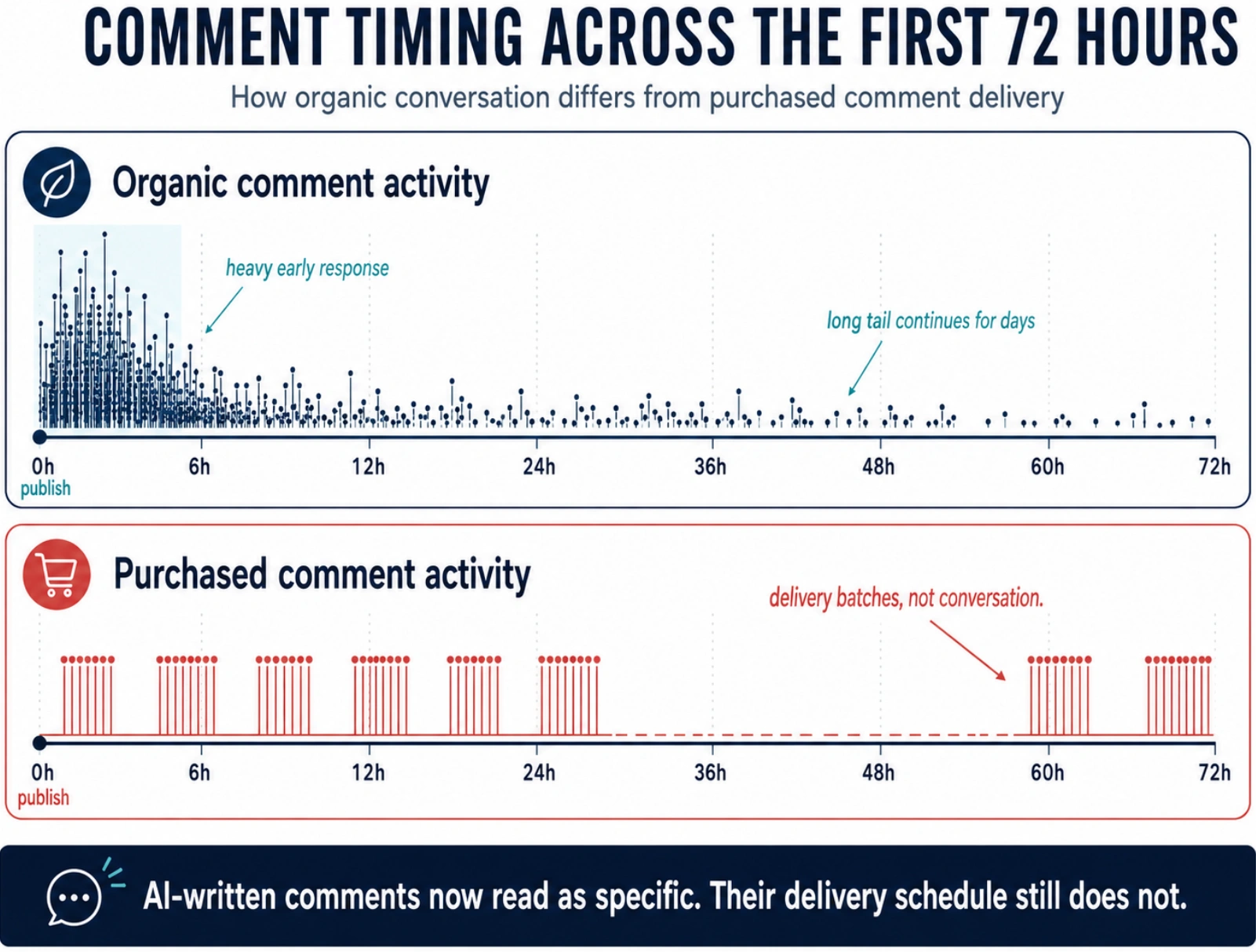
Reply behaviour is harder to fake than comments. Look at whether commenters return to reply to the creator’s responses, and whether they comment across multiple videos over months. Purchased engagement is almost always transactional and single-touch.
The direction of travel here is that surface-level manual inspection gets less reliable each year, while the structural signals (view variance, watch-through, growth patterns, share ratios) hold up because they are expensive to fake at scale.
FAQ
How do I know if my TikTok followers are bots? Compare your engagement rate to the median for your follower tier, not to the platform average. If you are a nano creator below 4.9% or a micro creator below 3.3%, look at your growth chart for unexplained spikes. Also check whether your view counts vary between videos: a flat view count across varied content is a stronger bot indicator on TikTok than a low follower-to-following ratio.
What percentage of fake followers is normal on TikTok? Per Modash’s published bands, bigger creators typically carry 20% to 30% fake followers and smaller creators under 50,000 followers sit around 10% to 20%. Under 25% is the range to aim for, and above 50% should be avoided. Zero is not the target, because every account accumulates bot followers passively over time.
Can I check someone else’s TikTok for bots? Yes. Follower counts, engagement, comments, and posting history are all public, so the manual five-signal check works on any account. For audience credibility percentages, which require analysing the follower base itself, you need a tool with access to that data.
Is a low engagement rate always a sign of fake followers? No. Audience decay after a viral video, a shift in content niche, or a posting gap will all depress engagement without any fraud involved. Fake followers are the likely explanation when a low engagement rate appears alongside a growth spike that no video accounts for, or alongside view counts that stay flat across everything the creator posts.
Does TikTok penalise creators for having fake followers? TikTok’s Integrity and Authenticity policy states that it removes fake likes, followers, and other inflated signals when it detects accounts with inauthentic metrics, and it operates a separate enforcement category that makes accounts ineligible for For You feed recommendation. Beyond enforcement, bought followers do not generate the watch-time and completion signals that TikTok’s ranking system uses, so a padded audience contributes nothing to the reach a creator earns per video.
Vetting TikTok creators before you spend? Run any handle through Favikon’s TikTok profile analyzer to see audience credibility, tier-adjusted engagement, and growth history in one view. Or start from the Instagram version of this check if that is where your campaign lives.
Others articles
.png)

