How to Check Influencer Audience Demographics (2026 Guide)
Reach, follower count, and engagement rate tell you how loud an influencer is. Audience demographics tell you who's actually listening. This guide covers every key demographic metric — age, gender, location, follower credibility, brand affinity, and more — and shows you how to use Favikon's analytics dashboard to verify them before you spend a dollar on any campaign.

How to Check Influencer Audience Demographics
Every influencer partnership starts with the same question: does this creator actually reach the people I'm trying to sell to? The answer isn't in their follower count. It isn't in their engagement rate. It's in their audience demographics.
Demographics data tells you exactly who an influencer's followers are — their age, gender, location, language, interests, and how real they are. Without it, you're running campaigns based on assumptions. With it, you can match influencers to your target buyer with the same precision you'd bring to paid advertising targeting.
This guide breaks down every demographic metric worth tracking, explains what each one means for campaign performance, and shows you exactly how to pull this data using Favikon's Influencer Analytics — so you can vet any creator in minutes before you ever reach out.
1. Why Audience Demographics Matter More Than Follower Count
The influencer marketing industry spent years optimizing for reach. Bigger audiences meant bigger campaigns. Then brands started measuring results — and realized that reach without relevance produces poor ROI.
A beauty brand that partners with a lifestyle influencer whose audience skews 60% male in the 45–54 age bracket isn't getting value from that campaign, regardless of how impressive the follower count looks. An enterprise software company that pays for a placement with a creator whose followers are mostly Gen Z students is burning budget. Audience mismatch is one of the most expensive and common mistakes in influencer marketing.
What Demographics Data Actually Prevents
• Spending budget on creators whose audiences will never convert for your product
• Running geo-targeted campaigns with creators whose followers are concentrated in the wrong markets
• Partnering with creators who have inflated follower counts from bots or mass-follow tactics
• Missing your actual target buyer entirely because you optimized for niche fit without checking who the audience really is
• Producing content that doesn't resonate because you didn't understand the audience's interests and language
The Business Case: Demographics Drive ROI
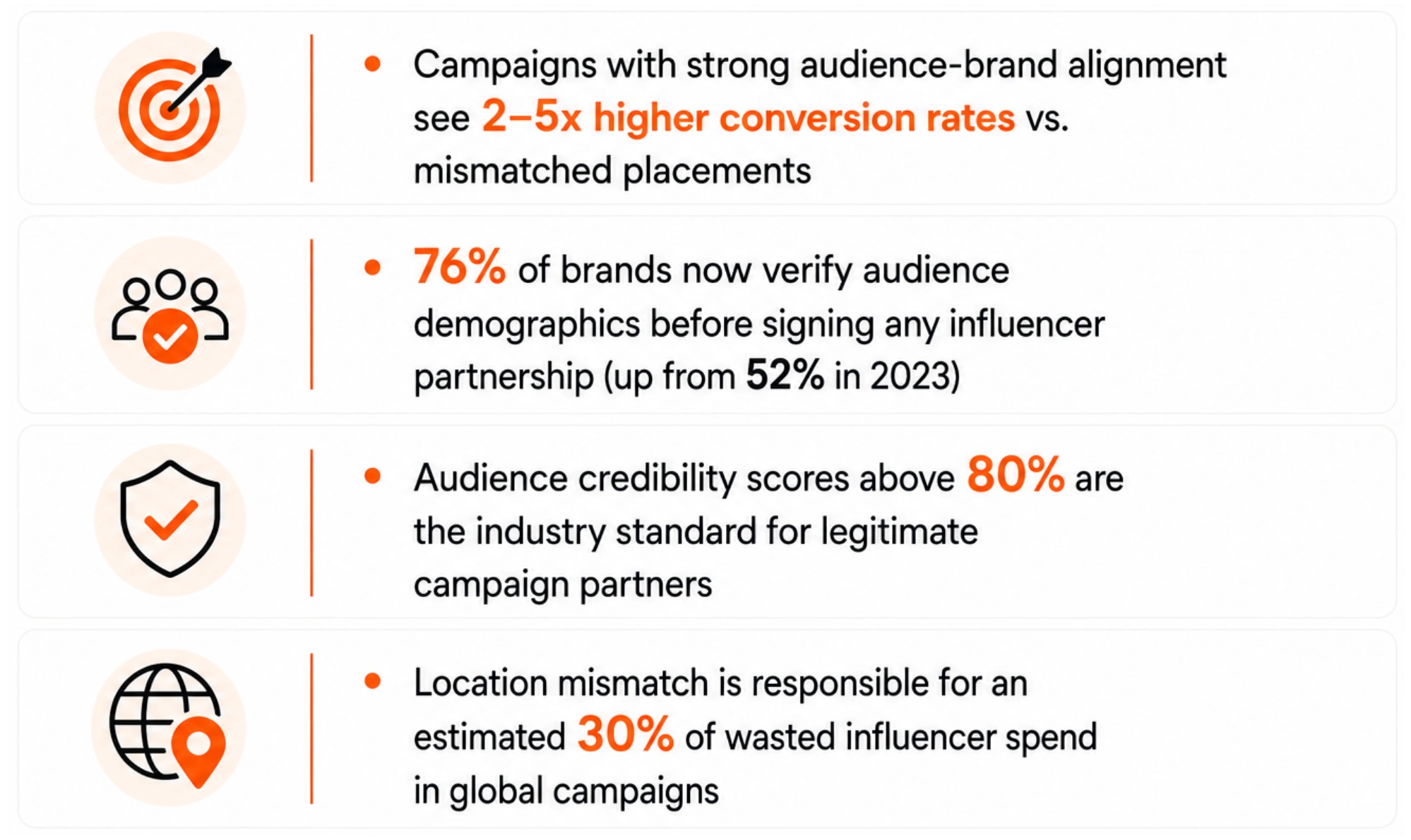
When audience demographics align tightly with a brand's ideal customer profile, influencer campaigns consistently outperform. Conversion rates from matched campaigns run 2–5x higher than mismatched placements. Return on ad spend improves. Customer acquisition costs drop. And the content tends to perform better organically because it's landing in front of people who are genuinely interested.
📊 The ROI Impact of Audience Matching
2. The 7 Audience Demographics Metrics That Matter
Not all demographics data is equally useful for every campaign. Here's a breakdown of every key metric available in Favikon's Analytics dashboard, what it measures, and why it matters for your decision-making.
1. Follower Credibility Score
The credibility score shows the percentage of an influencer's followers that appear to be genuine, real accounts — as opposed to mass-follow bots, inactive ghost accounts, or suspicious profiles.
Favikon's credibility breakdown categorizes followers into: Real followers, Mass followers (accounts following thousands of people with little engagement), Influencer accounts (other creators), and Suspicious accounts (likely bots or purchased followers).
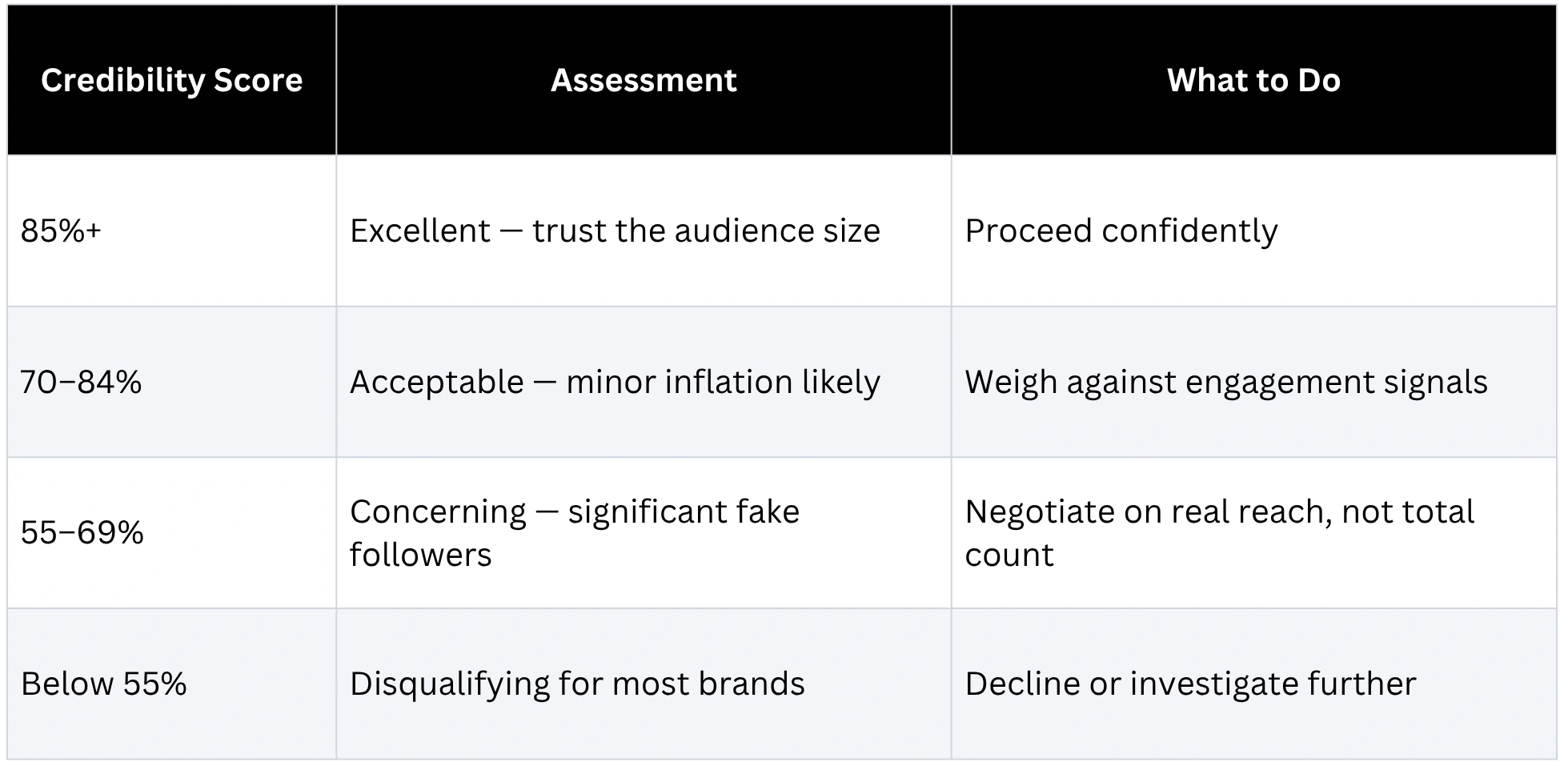
A high follower count with a low credibility score is one of the most common red flags in influencer vetting. Always check this metric first — if it fails, no other data point rescues the partnership.
2. Notable Followers
This metric surfaces verified, high-profile, or particularly influential accounts within an influencer's follower base. Industry journalists, executives, brand accounts, and verified professionals in the following list signal something important: the influencer has authority within their category, not just volume.
For B2B brands in particular, a creator whose followers include decision-makers in relevant industries is often worth more than a creator with triple the followers but no notable professional audience.
3. Audience Reachability
Reachability measures how many accounts each of the influencer's followers is themselves following. The logic: if a follower follows 5,000 accounts, any single piece of content they see competes with thousands of others for their attention. Followers who follow fewer accounts are more likely to actually see, read, and engage with each post.
Favikon scores this as the average number of accounts followed per follower. Lower numbers mean better reachability. Audiences where the majority follow fewer than 1,500 accounts indicate a high-attention, less-cluttered following.
4. Age and Gender Distribution
The most directly actionable demographic data for most brands. Age and gender breakdowns show you whether the influencer's audience matches your target buyer profile.
Favikon surfaces this as a percentage breakdown across standard age brackets (13–17, 18–24, 25–34, 35–44, 45–54, 55+) and gender split. Use this to:
• Confirm the influencer reaches your core age demographic
• Identify whether gender skew aligns with your buyer (important for beauty, fashion, fitness, and parenting categories)
• Catch mismatches before they cost you — an 18–24 skewed audience may not be the right fit for a premium financial product
5. Location and Language
Location data shows the geographic distribution of an influencer's followers — by country and often by city. Language data shows what languages the audience uses.
This is critical for any campaign with a geographic component: regional product launches, market-specific offers, or campaigns requiring local cultural relevance. An influencer with 500K followers but 65% concentrated in markets where your product doesn't ship is not the right partner for a sales-driven campaign — regardless of their content quality.
Always cross-reference location with your product's availability and the campaign's target markets before committing.
6. Brand and Interest Affinity
Affinity data reveals what brands, topics, and categories the influencer's audience is already engaged with — based on what they follow and interact with on the platform.
For brands, this is a relevance confirmation tool. If you're launching a fitness supplement and the influencer's audience shows strong affinity for nutrition, health content, and athletic brands, you have strong evidence of thematic alignment beyond just the influencer's own niche. Conversely, if the audience skews heavily toward entertainment and gaming with no health affinity, expect lower engagement with your product message.
7. Audience Lookalikes
Favikon's lookalike feature identifies other creators whose audiences share similar demographic profiles.
This is useful for two scenarios:
• You've found a great-fit creator but they're outside your budget — use lookalikes to find comparable alternatives at a different tier
• You're building a multi-creator campaign and want to ensure reach without significant audience overlap — lookalikes help you diversify intelligently
3. How to Check Influencer Audience Demographics in Favikon: Step-by-Step
Here's exactly how to pull full audience demographics for any creator using Favikon's platform:
1. Go to Favikon's Search or Discovery section
Navigate to app.favikon.com and open the Search / Discovery panel. You can search for a specific creator by name, handle, or keyword — or browse by niche and filter by platform.
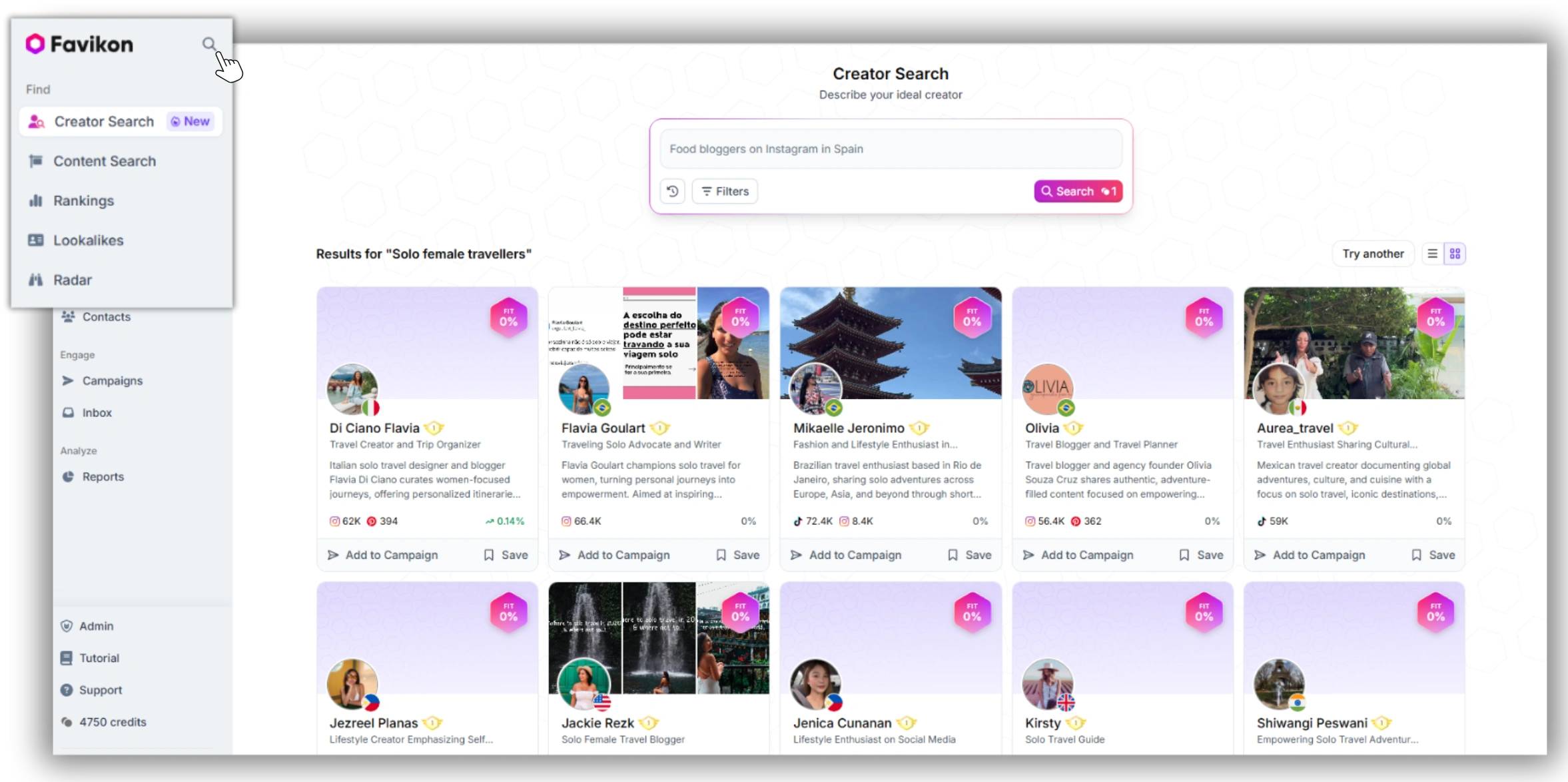
2. Search for the influencer you want to analyze
Use the search bar in the top right to find the creator. You can search by name, social handle, or niche keywords. Favikon covers creators across Instagram, TikTok, YouTube, LinkedIn, X, Substack, and more.
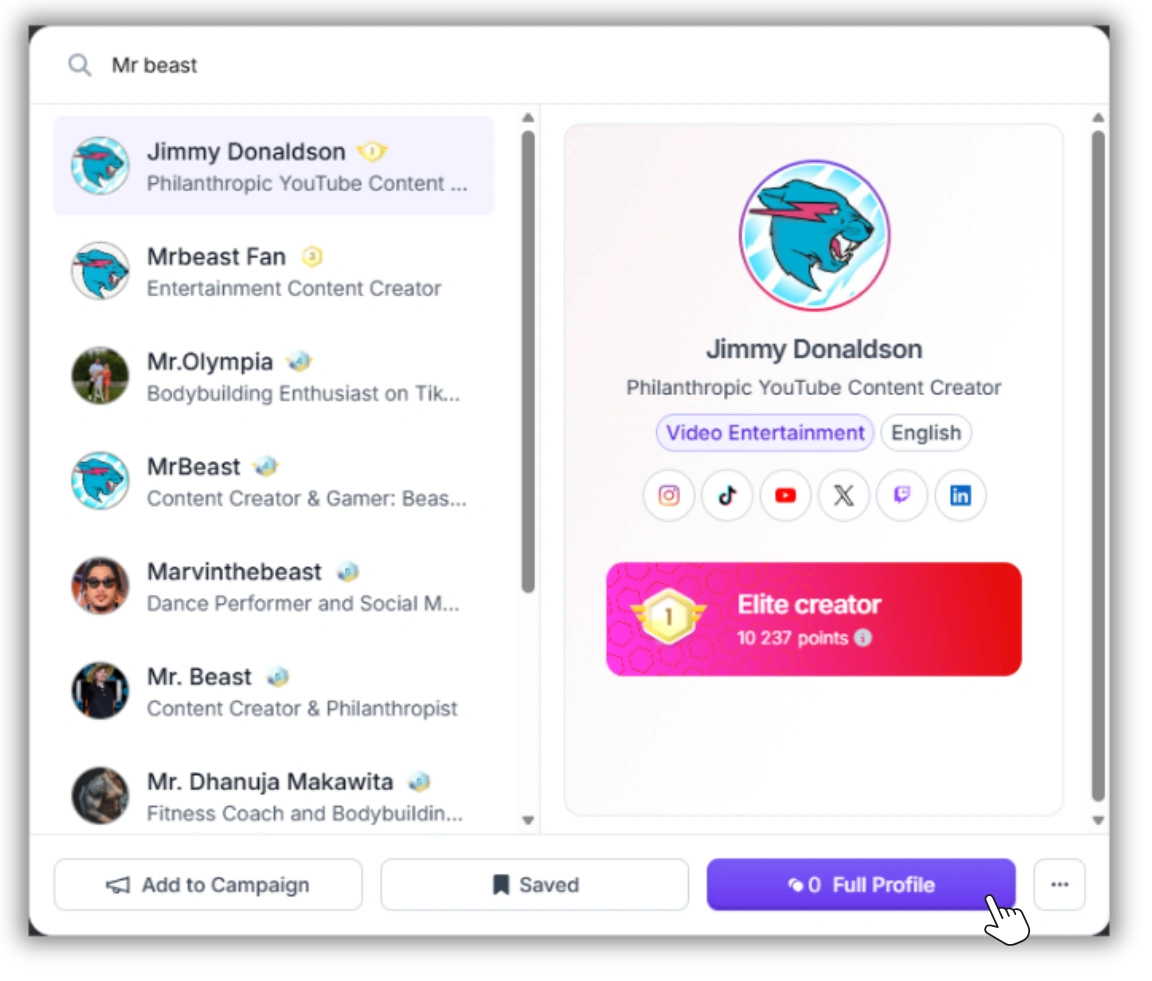
3. Open the creator's profile page
Click on the creator's profile to access their full analytics dashboard. You'll see an overview of their performance metrics, content activity, Favikon Score, and platform presence.
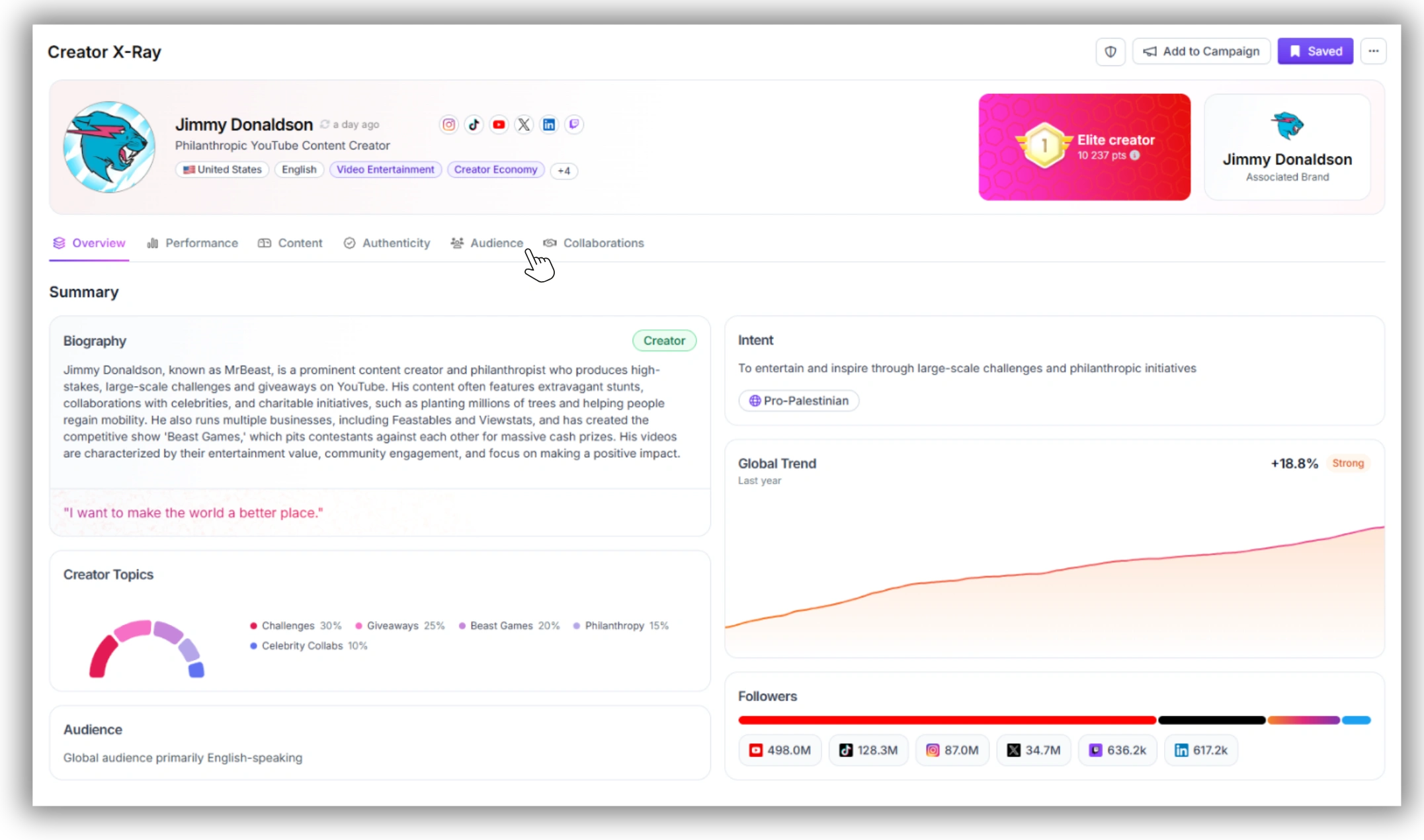
4. Navigate to the Audience tab
On the creator's profile page, scroll down and click the Audience tab. This is where all demographic data lives: follower credibility, age and gender breakdown, location, language, brand affinity, notable followers, reachability, and audience lookalikes.
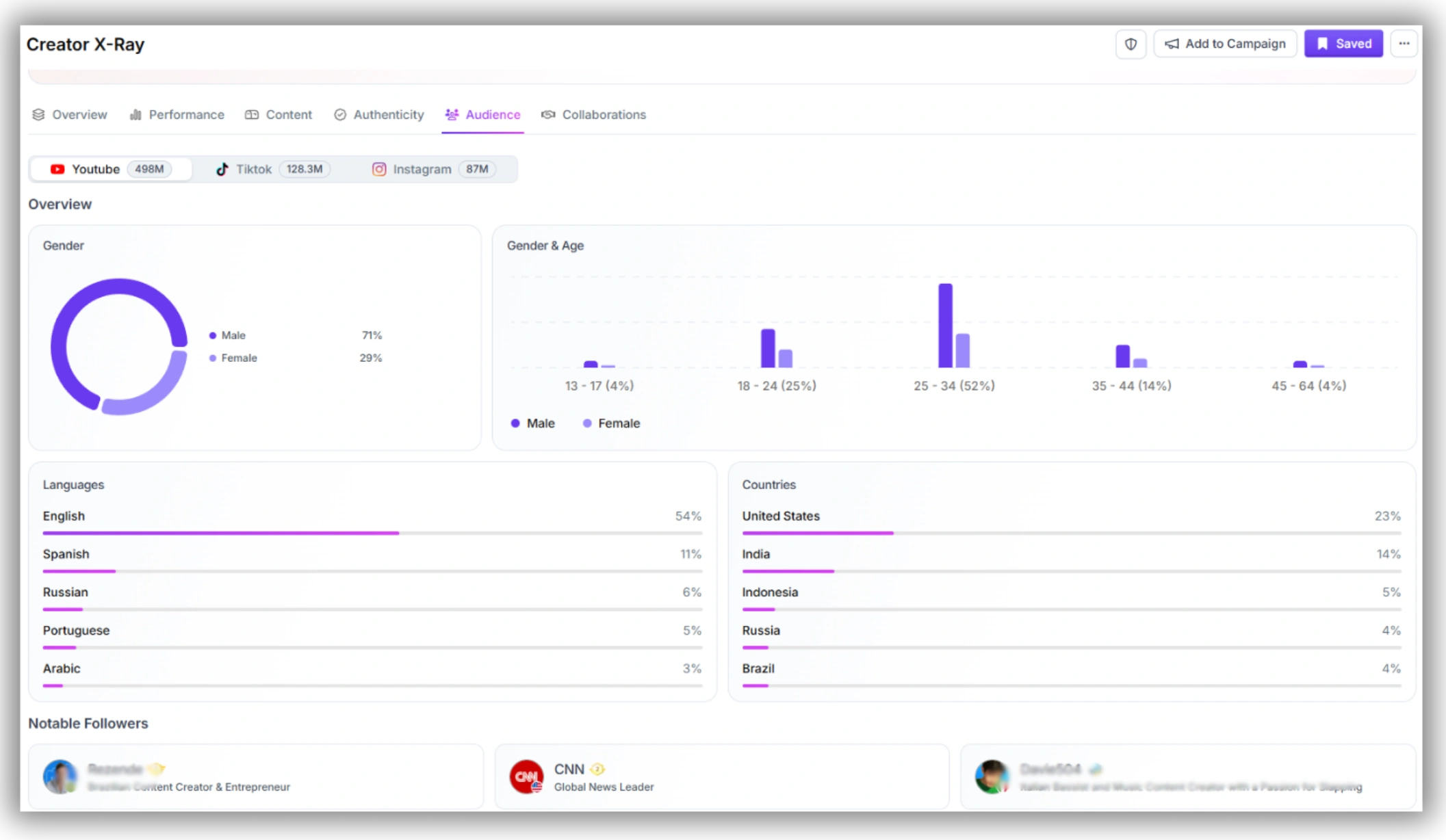
5. Review and validate against your campaign criteria
Work through each metric against your target audience profile. Use the benchmarks in this guide to assess credibility scores, check that age/gender/location distributions match your buyer, and verify brand affinity alignment before moving to outreach.
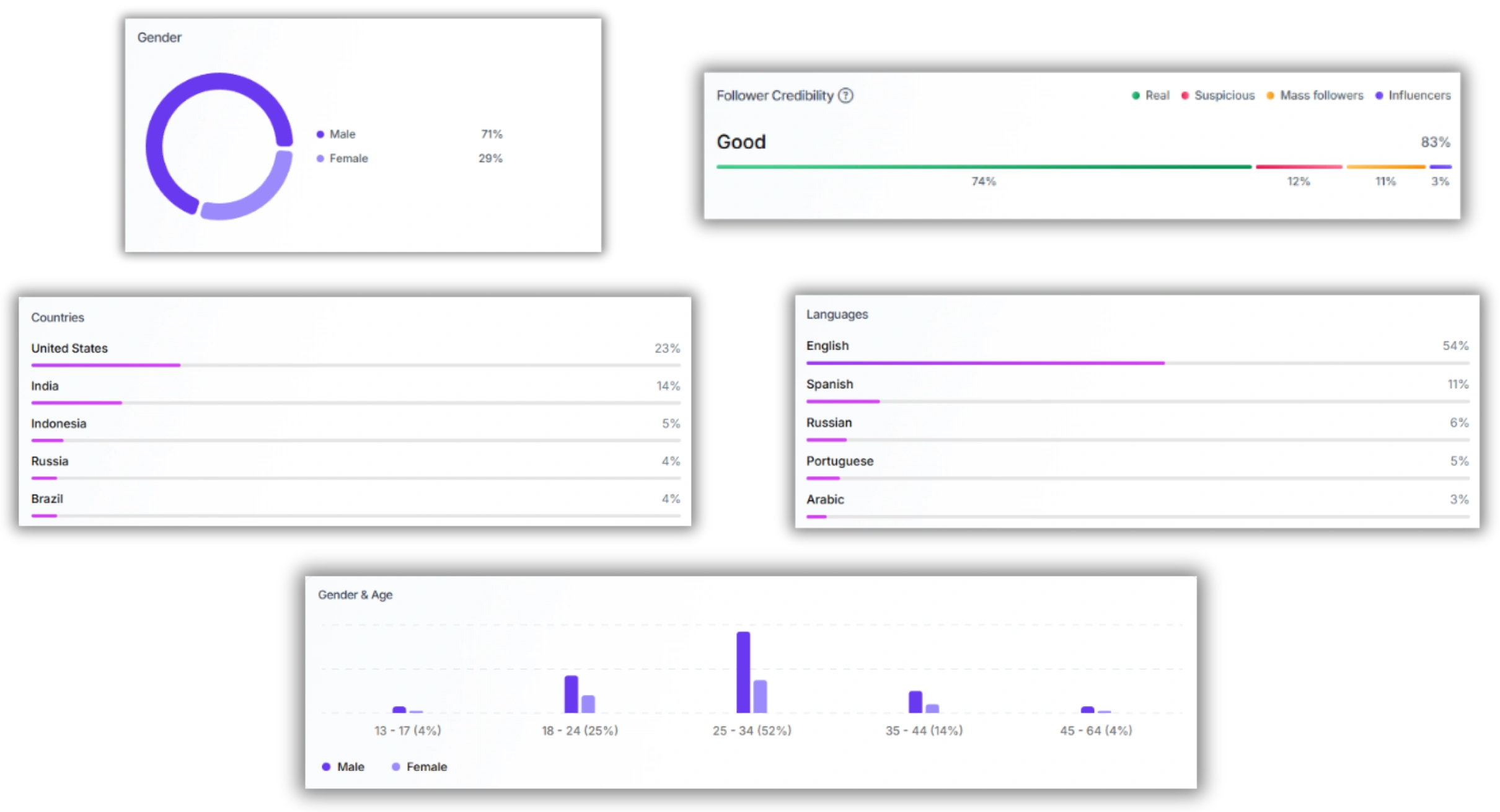
Access full audience demographics for any influencer → favikon.com/products/influencer-analytics
4. Building a Demographics Validation Checklist
Before reaching out to any influencer, run through this checklist. It takes less than 5 minutes per creator using Favikon's analytics dashboard — and it prevents the most common and costly demographic mismatches.
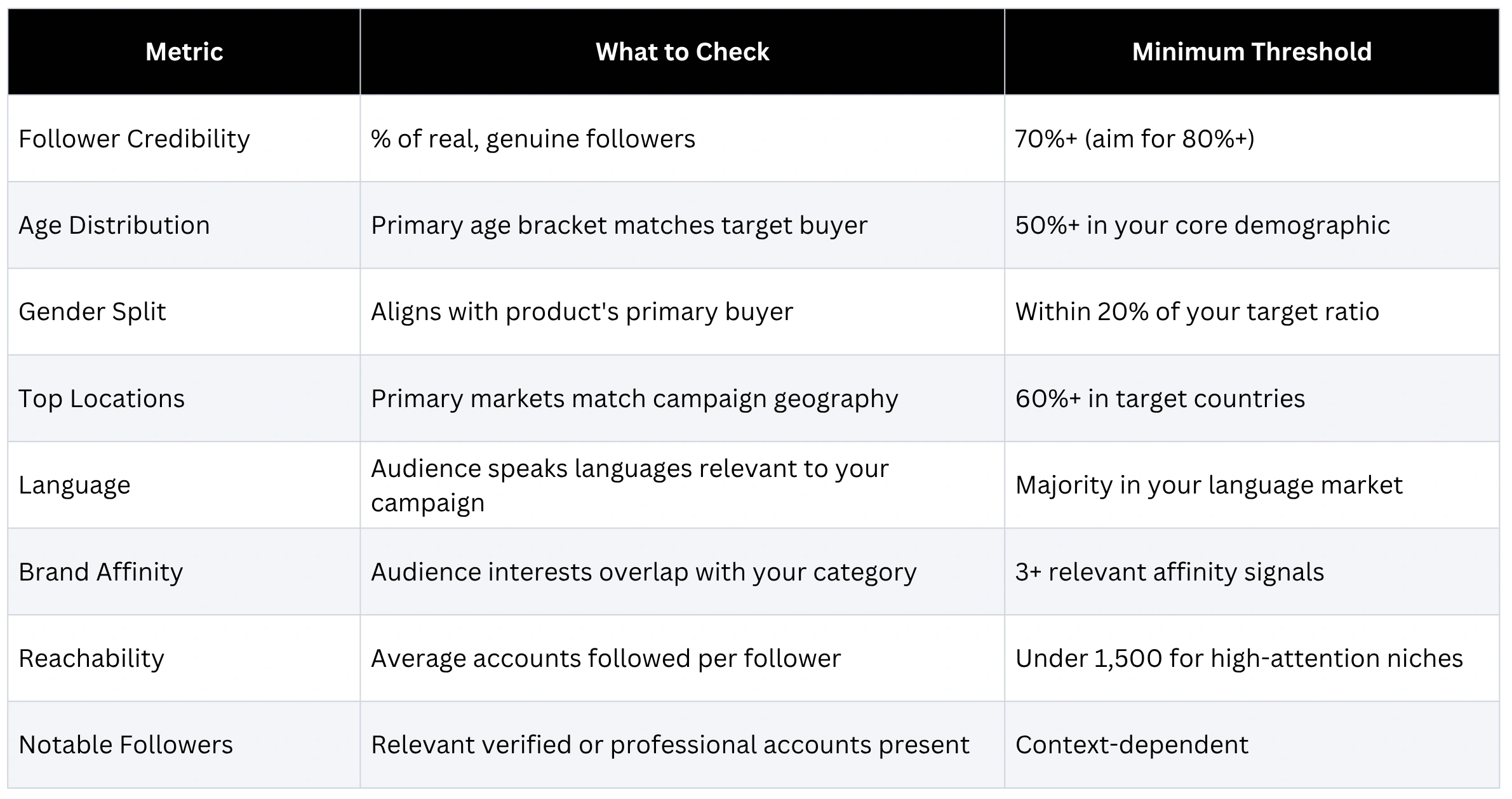
Not every metric carries equal weight for every campaign. For a global e-commerce brand, location distribution is critical. For a B2B SaaS product, notable followers and professional demographic concentration matter more. Weight these criteria against your specific campaign goals before scoring any creator.
5. Practical Example: Validating an Influencer for a Women's Wellness Brand
Let's walk through a real-world demographics check. You're marketing a premium women's supplement brand targeting women aged 25–44 in the US and UK. You've found a health influencer on Instagram with 180,000 followers and strong content. Here's how the demographics check plays out in Favikon.
What You're Looking For
• Follower Credibility: Above 75% — you need confidence the audience is real before any other metric matters
• Gender Split: 70%+ female — this is a women's product
• Age Breakdown: Strong concentration in 25–44 — specifically the 25–34 and 35–44 brackets
• Top Locations: US and UK should together represent 50%+ of the audience
• Brand Affinity: Signals for wellness, nutrition, fitness, natural beauty — indicates audience receptivity to your product message
Reading the Results
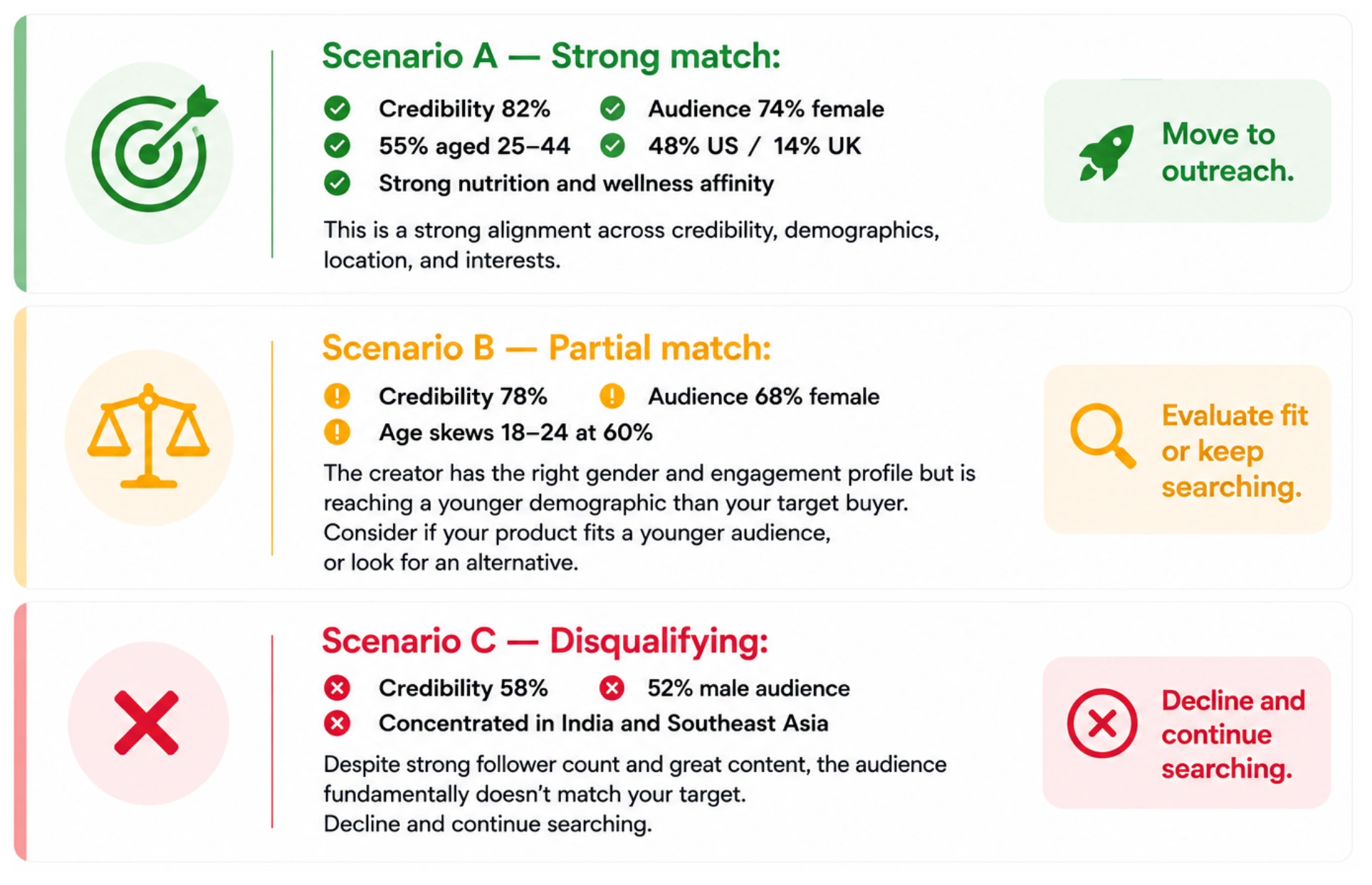
Search and validate influencers for any campaign using Favikon
6. Using Demographics to Compare Multiple Influencers
Once you've identified a shortlist of potential partners, audience demographics become your primary comparison tool. Here's how to use demographic data to make final selection decisions efficiently.
Build a Side-by-Side Comparison
For each shortlisted creator, export the key demographic metrics from Favikon and build a comparison matrix. The column headers should be your must-have criteria; the rows are your candidates. Score each cell green (meets threshold), yellow (marginal), or red (fails). The creator with the most green cells in the highest-priority columns wins.
Prioritize Precision Over Reach
When comparing two influencers — one with 500K followers and 45% audience match, another with 80K followers and 91% audience match — the smaller creator typically delivers better results for a niche campaign. Precision targeting almost always beats raw reach when your product has a specific buyer profile.
Use Favikon's influencer database to run this kind of comparison at scale. Filtering by demographic criteria before opening individual profiles saves significant time when evaluating a long shortlist.
Overlapping Audiences: A Hidden Efficiency Problem
For multi-creator campaigns, audience overlap is worth checking. If two influencers share 60% of their audience, you're paying twice to reach the same people. Use Favikon's lookalike and audience data to select creators whose follower bases are complementary rather than redundant — maximizing unique reach across your campaign budget.
7. Red Flags: Audience Demographics That Should Stop a Partnership
Not all demographic mismatches are deal-breakers — some can be worked around. But these specific patterns are strong signals to pause or walk away entirely.
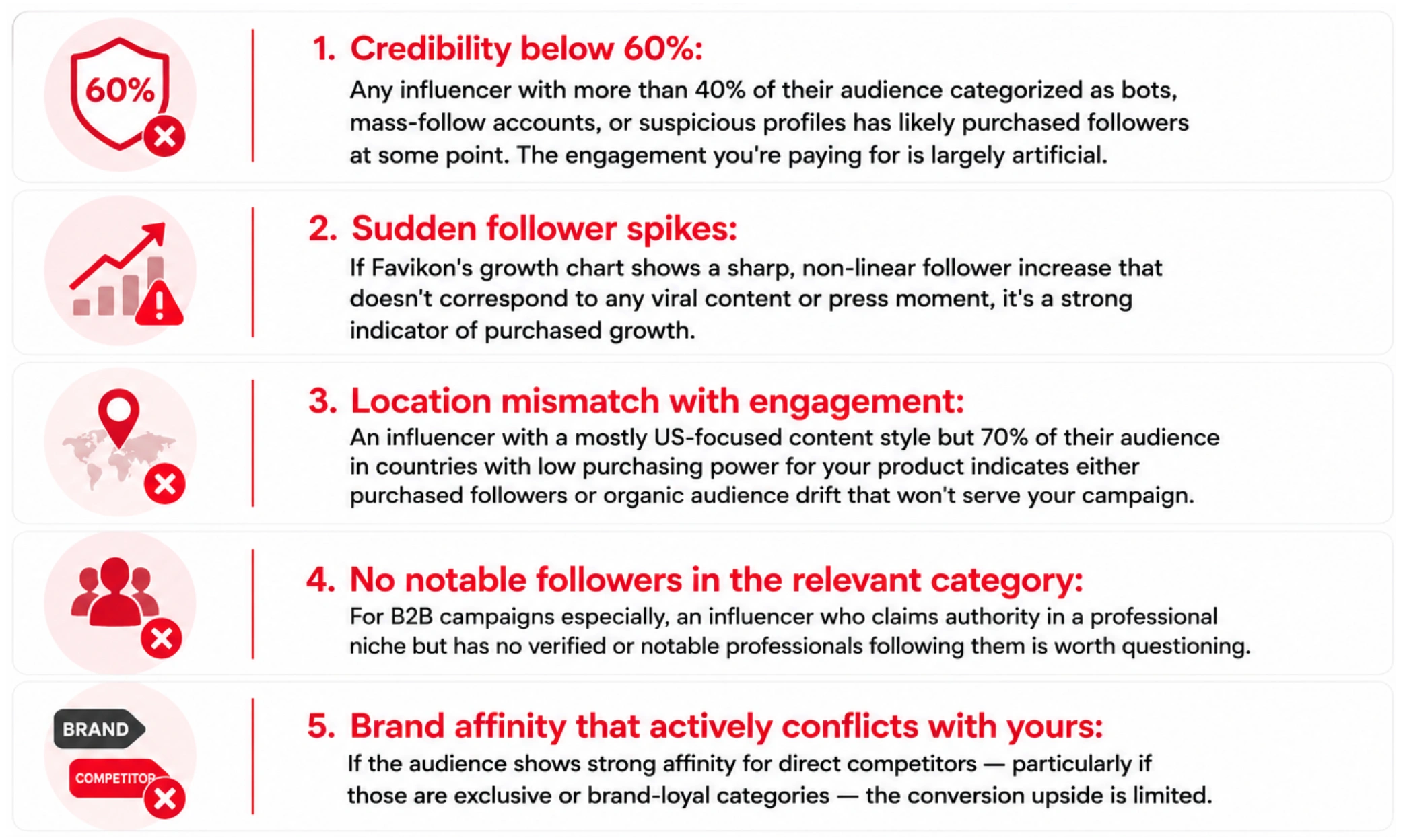
⚠️ Key rule: Always check follower credibility before any other metric. A failed credibility score invalidates every other data point — engagement rate, niche fit, and content quality included. An 8% engagement rate from 60% fake followers is not a 8% engagement rate.
8. Platform-Specific Demographic Considerations
Audience demographics don't just vary by influencer — they vary by platform. The same creator may have meaningfully different audience profiles across Instagram, TikTok, and YouTube. Here's what to know.
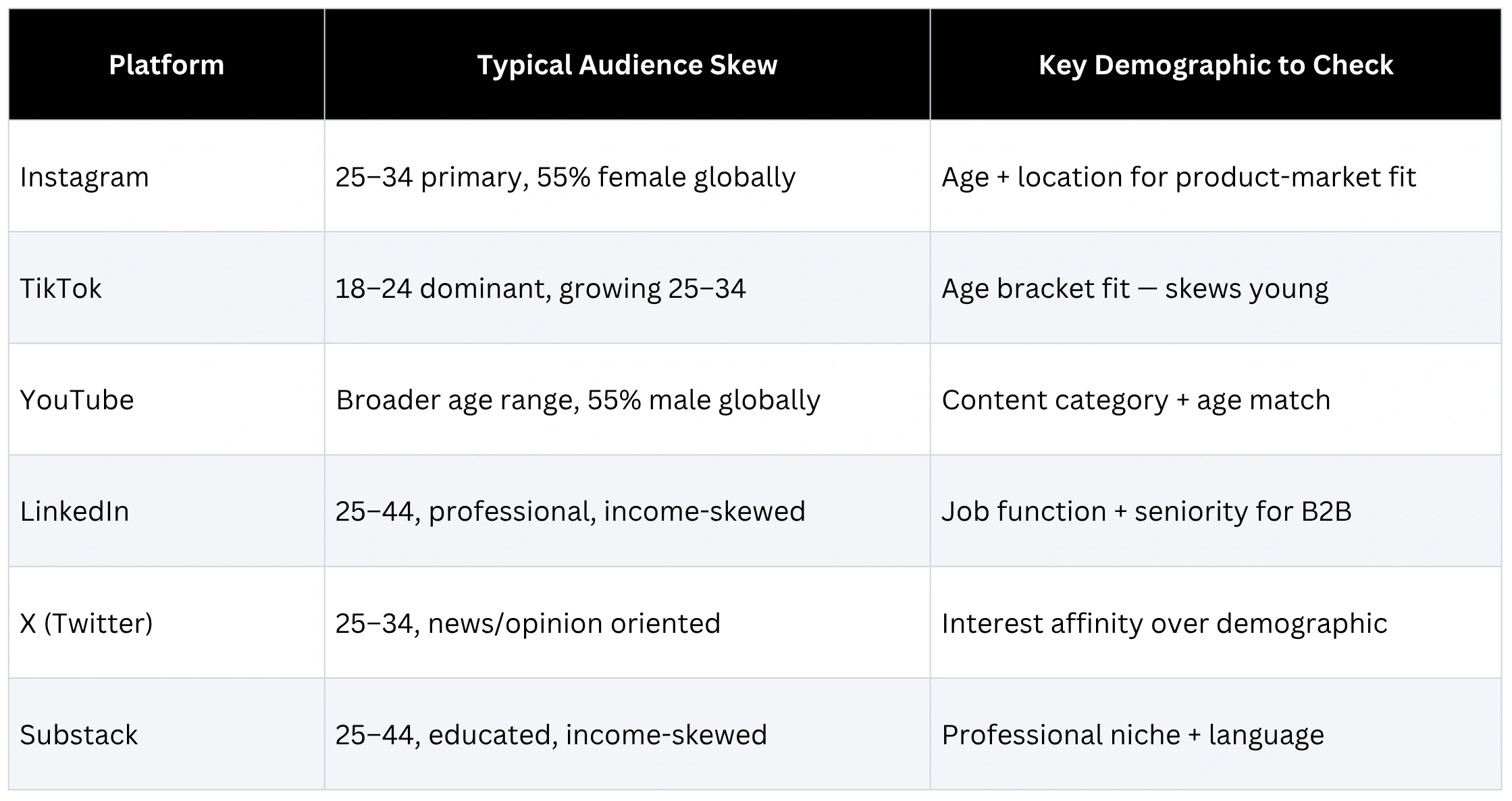
For multi-platform influencer campaigns, Favikon's analytics provides platform-specific audience data for each connected account on a creator's profile. This lets you validate demographics at the platform level — not just at the creator level — so you can choose which platform to activate for each campaign based on where the audience match is strongest.
9. How Often Should You Re-Check Audience Demographics?
Audience demographics aren't static. Follower bases shift over time as creators grow, pivot niches, go viral in unexpected communities, or attract followers through collaborations with other creators. A creator you vetted 12 months ago may have a meaningfully different audience profile today.
Recommended Re-Validation Schedule
• Before any new campaign: Always — regardless of how recently you last checked
• Every 6 months for ongoing retainer partners: Regular re-checks catch audience drift early
• After any viral moment or major growth spike: Rapid follower growth often changes the demographic composition of an audience significantly
• Before renewing an annual partnership: The audience that made a creator right for you 12 months ago may have evolved
Favikon's real-time analytics make re-validation fast — open the Audience tab and the data is current. Build this check into your campaign planning process as a non-negotiable step, not an optional review.
Conclusion
Follower count gets attention. Engagement rate confirms activity. But audience demographics answer the only question that actually matters before any campaign: are these the people I need to reach?
Running a proper demographics check before every influencer partnership takes less than 5 minutes with the right tool. Use Favikon's Influencer Analytics to pull credibility scores, age and gender breakdowns, location data, brand affinity, and audience lookalikes for any creator — then validate against your target customer profile before you ever send an outreach message.
The brands that consistently outperform in influencer marketing aren't the ones with the biggest budgets. They're the ones that match creators to audiences with precision — and demographics data is how that precision gets built.
FAQ: Checking Influencer Audience Demographics
What audience demographics should I check before partnering with an influencer?
The seven most important metrics are: follower credibility score, age and gender distribution, location and language breakdown, audience reachability, notable followers, brand and interest affinity, and audience lookalikes. Run all seven using a platform like Favikon before any outreach — each metric answers a different question about whether the audience is the right fit.
What is a good follower credibility score for influencers?
A credibility score above 80% is considered excellent and indicates a largely authentic audience. Scores between 70–80% are acceptable but suggest some inflation. Anything below 60% is a significant red flag that the influencer has likely purchased followers or benefited from follow-for-follow tactics that inflated their count with disengaged accounts.
Can an influencer have a high engagement rate but bad demographics?
Yes, and this is a common trap. High engagement with the wrong audience still doesn't deliver results. An influencer with 7% engagement who primarily reaches 16–22 year old males is not the right partner for a premium skincare brand targeting women 30–45 — regardless of how impressive the engagement looks. Always check demographics alongside engagement metrics.
How do I check if an influencer's followers are fake?
Use Favikon's follower credibility score on the Audience tab of any creator profile. Favikon categorizes followers as real, mass-follow accounts, influencer accounts, or suspicious/bot profiles. A credibility score above 75% indicates a mostly legitimate audience. Also look at the follower growth chart for sudden non-organic spikes, and assess whether comment quality matches the engagement volume.
How often should I re-check an influencer's audience demographics?
Before every new campaign — regardless of history. For ongoing partners, re-check every 6 months and always after major follower growth spikes or niche pivots. Audience demographics shift over time, and a creator who was a strong fit 12 months ago may have developed a materially different audience since.
Does Favikon show audience demographics for all platforms?
Yes. Favikon's analytics covers audience demographics across Instagram, TikTok, YouTube, LinkedIn, X, Substack, and other major platforms. For creators with multi-platform presence, you can view platform-specific audience data separately — which is particularly useful when deciding which channel to activate for a given campaign.
Also See 👀
🏆 HOW TO ANALYZE INFLUENCER FOR FREE
🏆 HOW TO FIND TIKTOK INFLUENCERS IN ANY NICHE?
HOW DOES FAVIKON RANK INFLUENCERS?
Others articles